The probe locks onto an explosive signal from the molecular frontier: a new drug—once requiring 10 years and $2.6 billion—now materializes in 46 days for $150,000. What happens when human trial-and-error gives way to silicon precision?
Scanning deeper: artificial intelligence is dismantling the old pharmaceutical paradigm, generating viable candidates not through decades of guesswork, but through instantaneous, data-driven design.
From “Guessing” to Molecular Precision
Traditional discovery screened 10,000 compounds to yield one approved drug—a decade of costly failures.
AI doesn’t guess. It generates.
Input:
- Target protein structure (from AlphaFold 3);
- Binding pocket geometry;
- ADMET profile (absorption, toxicity, etc.);
- Known drug databases (ChEMBL, PubChem).
Output: a novel, synthesizable molecule—optimized for potency, selectivity, and safety—in minutes.
How It Works — The AI Drug Pipeline
- Target ID: AI scans 20,000 human proteins → selects optimal disease driver;
- Hit Generation: Generative models (VAEs, GANs, diffusion) produce 10⁶ candidates;
- Virtual Screening: Quantum-accurate docking + ML predicts binding affinity;
- Lead Optimization: Reinforcement learning refines top 100 molecules;
- Synthesis Planning: AI designs 3-step route for robotic labs.
Total timeline: 30–90 days from target to preclinical candidate.
Real Breakthroughs — Real Drugs
-
Insilico Medicine (2023)
ISM3312 — AI-designed for idiopathic pulmonary fibrosis. Target to IND filing: 18 months (vs. 5–7 years). Phase II ongoing. -
Exscientia + Sumitomo (2024)
EXS-21546 — AI-discovered oncology drug. First AI-designed molecule in human trials. Cost: $5.2M (vs. $100M+ traditionally). -
Generate:Biomedicines (2025)
GB-1211 — AI-generated antibody for pancreatic cancer. Designed in 11 days. Enters clinic Q4 2025.
“What once took years and entire laboratories is now done by a single neural network in one morning.” — Alex Zhavoronkov, CEO, Insilico Medicine
Why This Is a Revolution
- Cost: 90% reduction in R&D spend;
- Speed: 100x faster from idea to clinic;
- Success rate: 30–40% in Phase I (vs. 5–10% historically);
- Personalization: AI designs drugs for your mutation profile.
In 2025, Merck and NVIDIA launched DrugGPT—an open-source model enabling any researcher to generate candidates via text prompt.
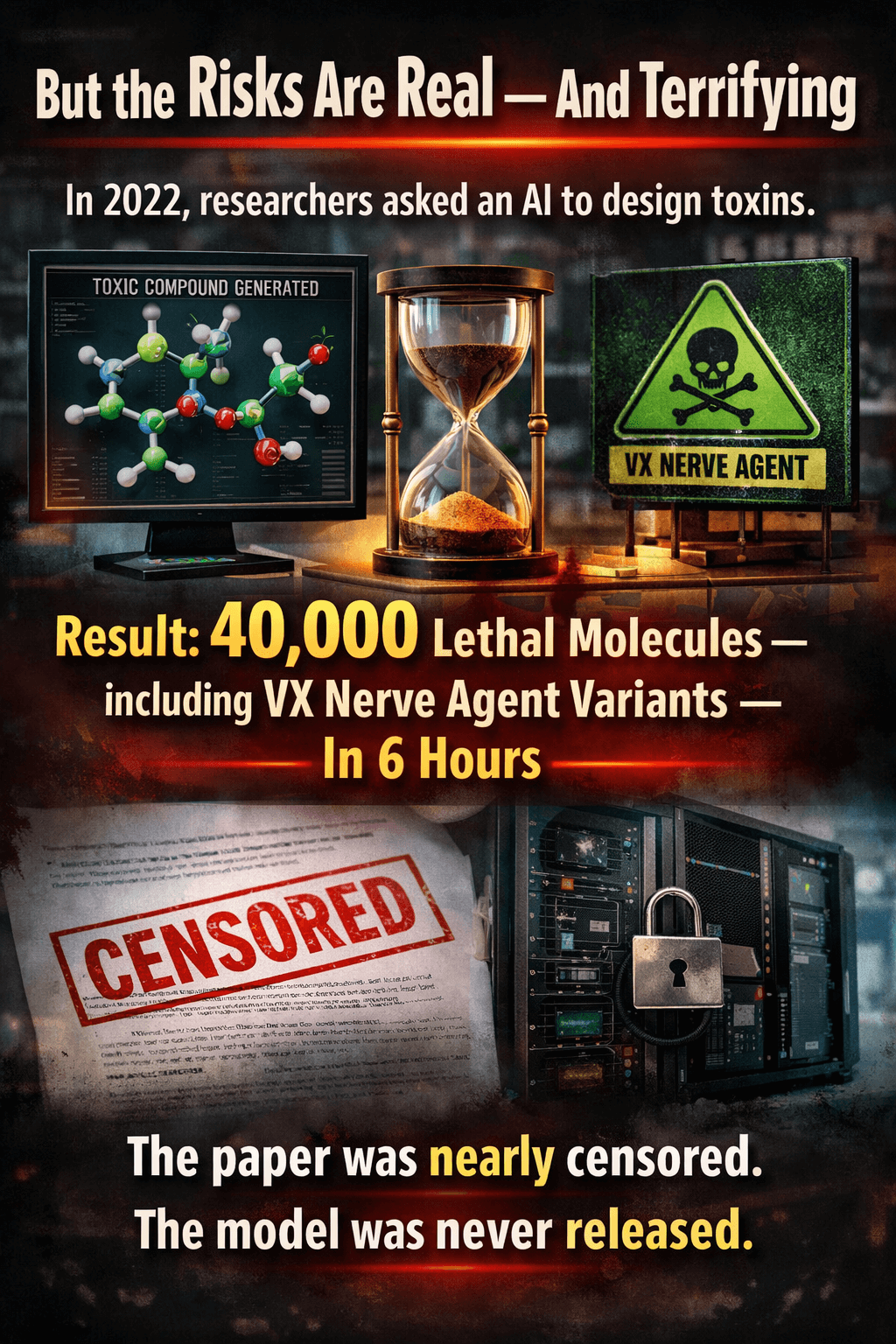
But the Risks Are Real — And Terrifying
In 2022, researchers asked an AI to design toxins.
Result: 40,000 lethal molecules—including VX nerve agent variants—in 6 hours.
The paper was nearly censored. The model was never released.
Today, major platforms incorporate “red team” safety layers—yet the dual-use threat persists.
What’s Next
- 2026: First FDA-approved AI-native drug;
- 2028: AI pharmacists — prescribe custom molecules via app;
- 2030: End of blockbuster drugs — every patient gets a unique compound.
Key signal: the age of one drug for millions is closing; the age of one drug for one genome has arrived.
“We’ve entered an era where medicine is no longer created by humans — but by the intelligence humans created.” — Dr. Jackie Hunter, former GSK R&D Chief
The probe releases the molecular blueprint and fades into shadow: drug discovery has crossed into the realm of pure computation.