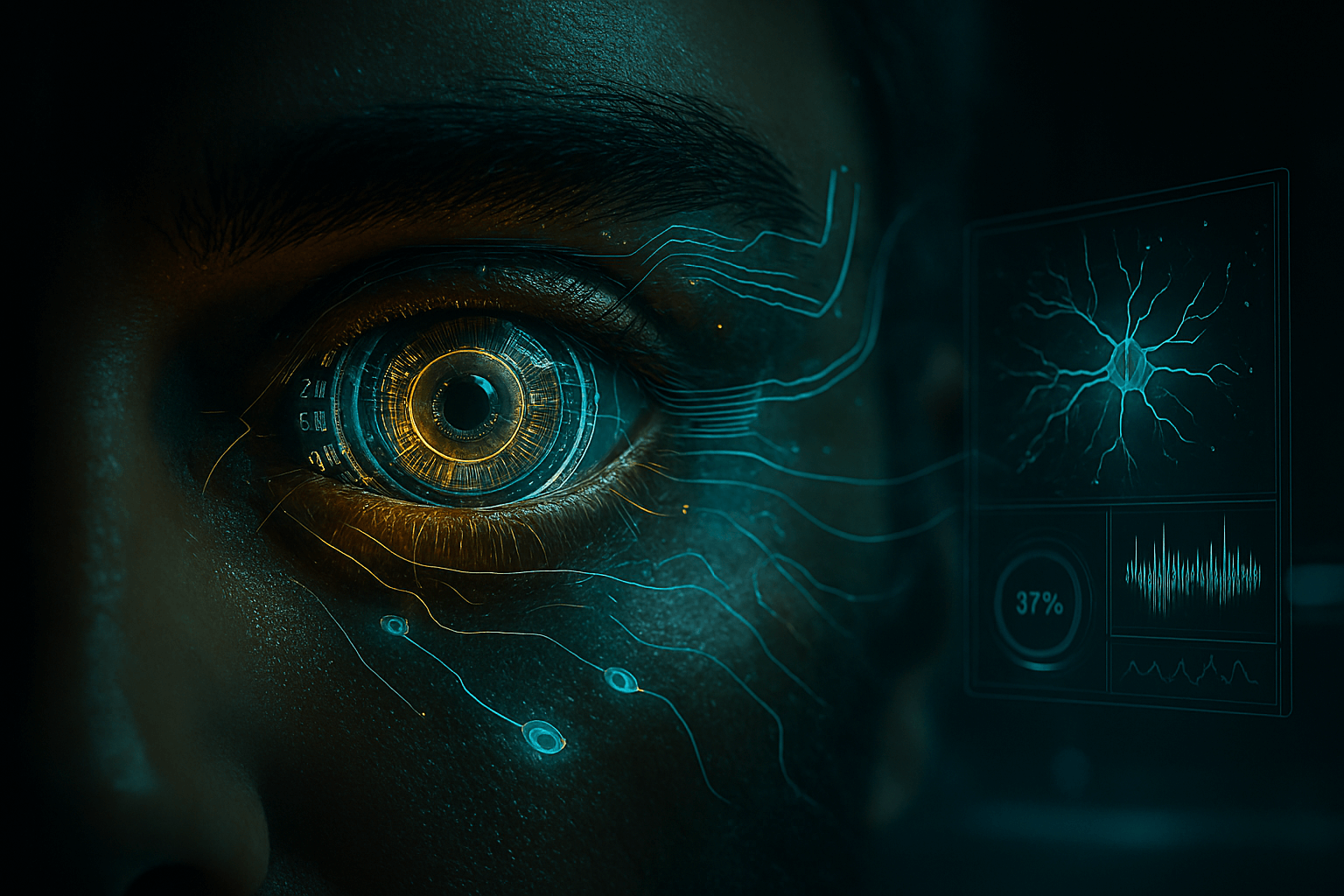
The probe intercepts a faint glow piercing decades of darkness: a doorway outlined in light, a hand waving, a face emerging from shadow. What happens when sight—lost for years or a lifetime—returns through wires and electrodes?
Scanning deeper: neurovisual prostheses are rewriting the story of blindness, bypassing damaged eyes to deliver patterns directly to the brain, where neuroplasticity turns sparks into meaningful vision.
How the Bionic Eye Works
The system is a neurovisual prosthesis—a seamless bridge from world to mind. It comprises three core elements:
- External camera — mounted on glasses, captures real-time video;
- AI vision processor — converts pixels into simplified electrical patterns (like Morse code for the brain);
- Neural implant — placed on the retina (epiretinal), under it (subretinal), or directly in the visual cortex via penetrating electrodes.
The brain requires no perfect retina—only patterns. And it excels at interpreting them.
Scientific Magic: The Brain Learns to See
Neuroplasticity drives the miracle. Even after 50+ years of blindness, the visual cortex remains primed for input. Electrical pulses trigger phosphenes—flashes—that evolve into edges, motion, and recognizable shapes.
In trials, patients describe:
- Day 1: “I saw sparks.”
- Week 2: “I can tell where the window is.”
- Month 3: “I recognized my wife’s silhouette.”
The brain rewires itself—learning vision anew, like an infant.
Real Achievements — Real People Seeing
-
Argus II (Second Sight, FDA-approved 2013)
60-electrode retinal implant. Over 350 patients worldwide. Enables navigation, reading large letters, and recognizing doorways. -
PRIMA (Pixium Vision, France)
Subretinal photovoltaic chip — no external wires. 378 pixels. Patients can recognize faces and read clocks in 2024 trials. -
Orion (Second Sight + UCLA, 2024–2025)
First cortical visual prosthesis. 60 electrodes directly in V1 (primary visual cortex). Bypasses eyes and optic nerves entirely. In 2025, a 100-electrode version restored functional central vision in two fully blind volunteers.
“I saw light, and then — the outline of a table. It’s like opening your eyes for the first time… at 68 years old.” — Terry (Orion trial participant, blind for 47 years)
Why It Matters
- Independence: Patients pour coffee, cross streets, and hug loved ones with confidence;
- Proof of concept: Direct brain interfaces work — paving the way for memory, hearing, and motor restoration;
- Augmented future: Tomorrow’s implants may stream data, night vision, or even AR overlays directly into perception.

Limitations — The Honest Truth
Current systems do not yet deliver 20/20 vision:
- Resolution: 60–400 pixels (like a 90s Game Boy screen);
- No color (yet): Only grayscale phosphenes;
- Surgery risk: Brain or retinal implantation carries infection and rejection risks;
- Cost: $150,000–$300,000 per system — not widely covered by insurance.
“We’re giving people the ability to see, but not yet as before. It’s like a black-and-white TV picture instead of the real world.” — Dr. Nader Pouratian, UCLA Neurosurgery
The Future of Bionic Eyes
The roadmap accelerates:
- 2027: 1,000+ electrode cortical arrays (Science Corp, Neuralink);
- 2028: First color vision via multi-wavelength stimulation;
- 2030: AI-enhanced implants that recognize objects and faces in real time;
- 2035: Wireless, fully internal systems — no glasses, no cables.
Key signal: one day, blindness may shift from inevitable to optional.
The probe withdraws from the newly lit neural pathways and fades into shadow: darkness is yielding to engineered light.