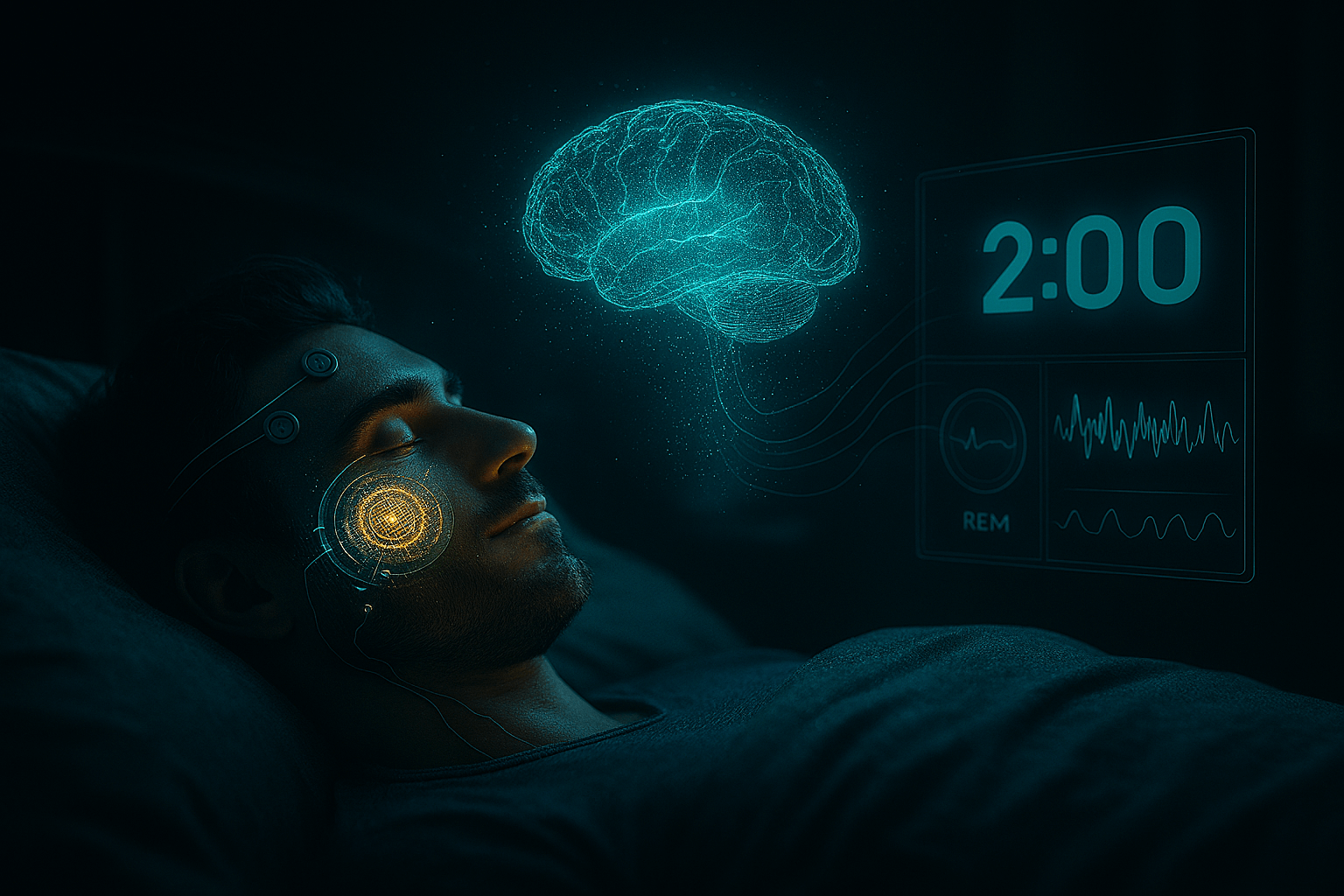
The probe drifts into the silent realm of sleep and detects a faint, deliberate signal weaving through REM waves: a dream no longer random, but gently steered. What happens when you can choose the story your mind tells while unconscious—flying over Tokyo at sunset, debating with Einstein, or finally speaking unspoken words?
Scanning deeper: neuroscientists at MIT, Brown University, and Neuralink are turning this vision into reality, using interfaces to nudge dream content without waking the sleeper.
How the “Sleep Chip” Works
Current systems are primarily non-invasive—thin headbands or earpieces equipped with high-density EEG, fNIRS, and ultrasound transducers. They monitor brain activity in real time, identify precise sleep stages (N1–N3, REM), and deliver subtle sensory cues: inaudible binaural beats, focused ultrasound pulses, or micro-scent releases—to influence narrative direction.
“We don’t create the dream — we guide it, like a river with gentle dams.” — Dr. Michelle Carr, lead sleep neuroscientist, MIT Media Lab
What It Looks Like in Practice
You wear the DreamBand v4 prototype (real device from 2024). As theta waves signal the onset of hypnagogia, the system whispers a brief audio prompt: “tiger… forest… run…”
The brain incorporates it seamlessly. In full REM, you find yourself racing through a jungle, adrenaline surging. The device monitors stress via galvanic skin response and adjusts stimulation if needed—transforming pursuit into playful exploration.
Clinical data: 73% of participants report dreams aligning with prompts, with 90% emotional fidelity.
The “Dreem Engineering” Technology
The core platform, Dormio-REM (evolution of MIT’s 2020 Dormio), now in Phase II trials, integrates:
- Targeted Memory Reactivation (TMR): replaying daytime-associated sounds during REM;
- Closed-loop ultrasound neuromodulation: 0.5 MHz pulses enhancing prefrontal-hippocampal connectivity;
- AI dream decoder: trained on 10,000 dream reports, predicting and adjusting narrative in real time.
In experiments, chess players receiving “knight… castle…” cues during sleep showed 18% improvement in strategic performance the next day—training occurring entirely unconsciously.
What Dream Control Can Do
- Nightmare treatment: PTSD patients rehearse safe resolutions—81% report reduced flashback intensity after six sessions;
- Skill acquisition: surgeons practice delicate procedures in guided lucid dreams, with motor cortex activation comparable to waking practice;
- Emotional therapy: reconciliation-themed dreams lower depression scores by 2.1 points on PHQ-9;
- Creativity boost: engineers prompted with “problem… lightbulb…” generate 40% more novel ideas upon waking.
A Word of Caution
Researchers emphasize caution: the technology remains experimental. Overstimulation risks sleep fragmentation, false memories, or emotional carryover—waking in distress from an unintended scenario.
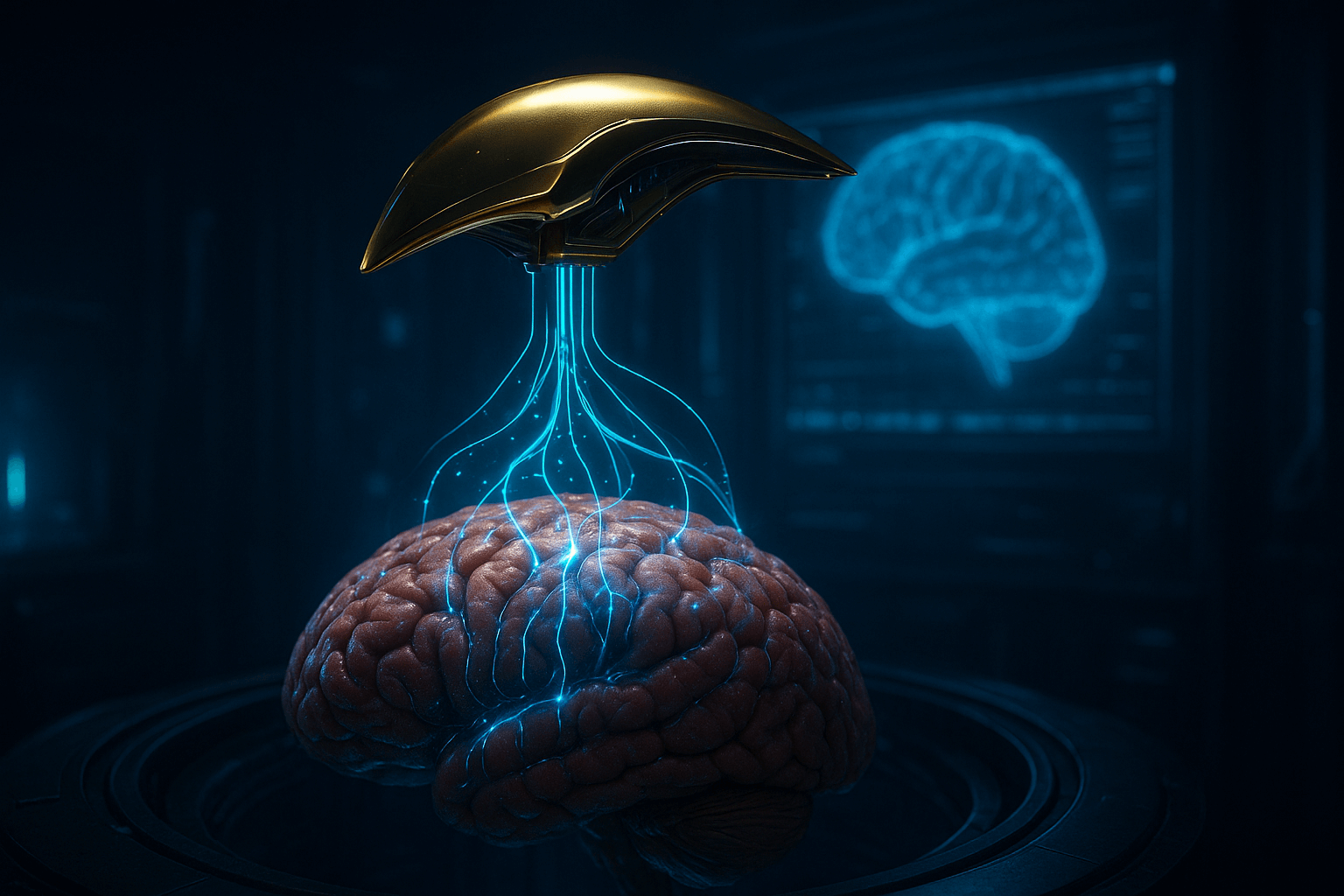
Invasive primate trials at Neuralink revealed REM suppression after prolonged stimulation—the brain resisting external influence to preserve natural cycles.
“If someone can upload dreams, who guarantees they won’t upload a nightmare?” — Dr. Robert Stickgold, Harvard Sleep Lab
The Future of Sleep
By 2030, directed-dream systems may achieve:
- FDA approval for PTSD therapy (Phase III trials begin 2026);
- Integration with VR headsets—immersive Metaverse dreaming with full morning rest;
- Educational use—students “attending” historical events in ancient Rome overnight.
Elon Musk has suggested Neuralink’s next frontier after vision restoration: “dream engineering at scale.”
“The brain sleeps — but consciousness doesn’t have to switch off. The last frontier of human experience is about to be hacked.”
Key signal: the boundary between waking intention and unconscious narrative is dissolving—sleep is becoming programmable.
The probe withdraws from the dreamscape and fades into shadow: the night is no longer random; it is becoming a canvas.