Glowing Plants: The Living Energy of the Future
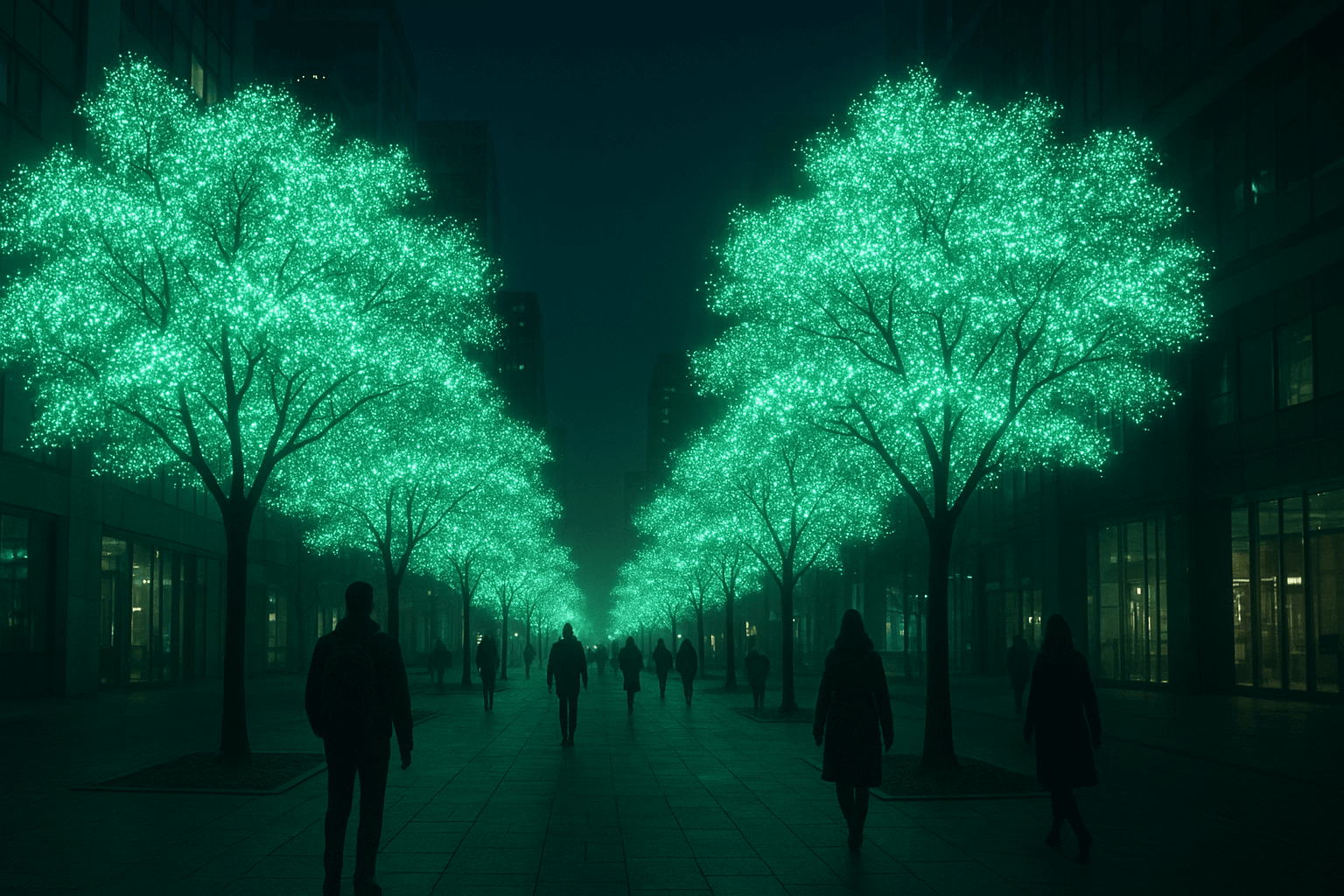
The probe captures a soft, ethereal glow rising from the biosphere: trees casting emerald light across darkened streets, vines tracing neon paths along walls, flowerbeds pulsing gently in the night. What happens when illumination no longer requires electricity—when living organisms become the lamps of tomorrow?
Scanning deeper: bioluminescent plants are transitioning from laboratory curiosity to commercial reality, harnessing natural light production to reshape energy use and urban nights.
Plants That Emit Light — No Electricity
In 2017, MIT engineers created the first glowing plants using luciferase nanoparticles. By 2024, genetically engineered petunias sustained glow for weeks—powered solely by photosynthesis.
Today, **Light Bio** markets **Firefly Petunias**—the first commercially available bioluminescent plant, shining **50x brighter** than early prototypes.
“We gave plants the ability to use their own energy to emit light.” — Dr. Karen Sarkisyan, Light Bio co-founder
How It Works — Biology Meets Photonics
Two approaches now coexist:
| Method | Duration | Brightness | Status |
|---|---|---|---|
| Nanoparticle Infusion | 4 hours | Low (reading light) | Research |
| Genetic Engineering | Entire lifecycle | High (street-level) | Commercial |
Genetic version: Four firefly genes inserted via **Agrobacterium**:
- Luciferase — the enzyme
- Luciferin — the fuel (recycled from caffeic acid)
- Regulators — turn glow on at night
Result: **Self-sustaining bioluminescence** — recharged daily by sunlight.
“It’s a biological lamp — living, self-healing, and beautiful.”
Why It Matters — Beyond Beauty
Global lighting consumes **15% of all electricity** — ~2,000 TWh/year. Replacing **10%** with biolight could eliminate **200 million tons of CO₂ annually**.
Real-world pilots (2025):
- Singapore: 200 glowing trees along Orchard Road — **no streetlights needed**;
- Amsterdam: Bioluminescent bike paths — **zero energy, zero maintenance**;
- Tokyo: Glowing cherry blossoms — bloom in light **and** color.
The Next Step — Programmable Light
CRISPR-Cas12 enables precise tuning:
- Color: Green, blue, violet, warm white;
- Intensity: From candle glow to floodlight;
- Pattern: Pulsing, breathing, or motion-triggered.
Coming 2026: **Glowing grass** for football fields — **no floodlights, no glare, no heat**.
Not Only Benefits — The Risks
Critics raise concerns:
- Gene flow: What if glowing pollen spreads to wild plants?
- Light pollution: Disrupts nocturnal animals (moths, bats);
- Ethics: Are we “playing God” with nature’s night?
**Light Bio’s solution**: **Sterile plants only** — no seeds, no spread. All trials in **contained urban zones**.
A World Where Nature Glows
By **2030**, we may witness:
- Living streetlights — 1 tree = 10 LED lamps;
- Home biolamps — a pot plant that replaces your bedside light;
- Glowing agriculture — farmers work at night under their own crops.
NASA is testing **glowing algae** for Mars habitats — **light + oxygen + food** from one organism.
“When light becomes alive, the boundary between nature and technology disappears.” — Dr. Michael Strano, MIT, pioneer of plant nanobionics
Key signal: illumination is returning to its biological roots—living light is ready to reclaim the night.
The probe lingers in the gentle glow and fades into shadow: the future is lit by life itself.